What Is Truth?
A Thomistic Reflection on the Dossier of Abuse Within the Catholic Church

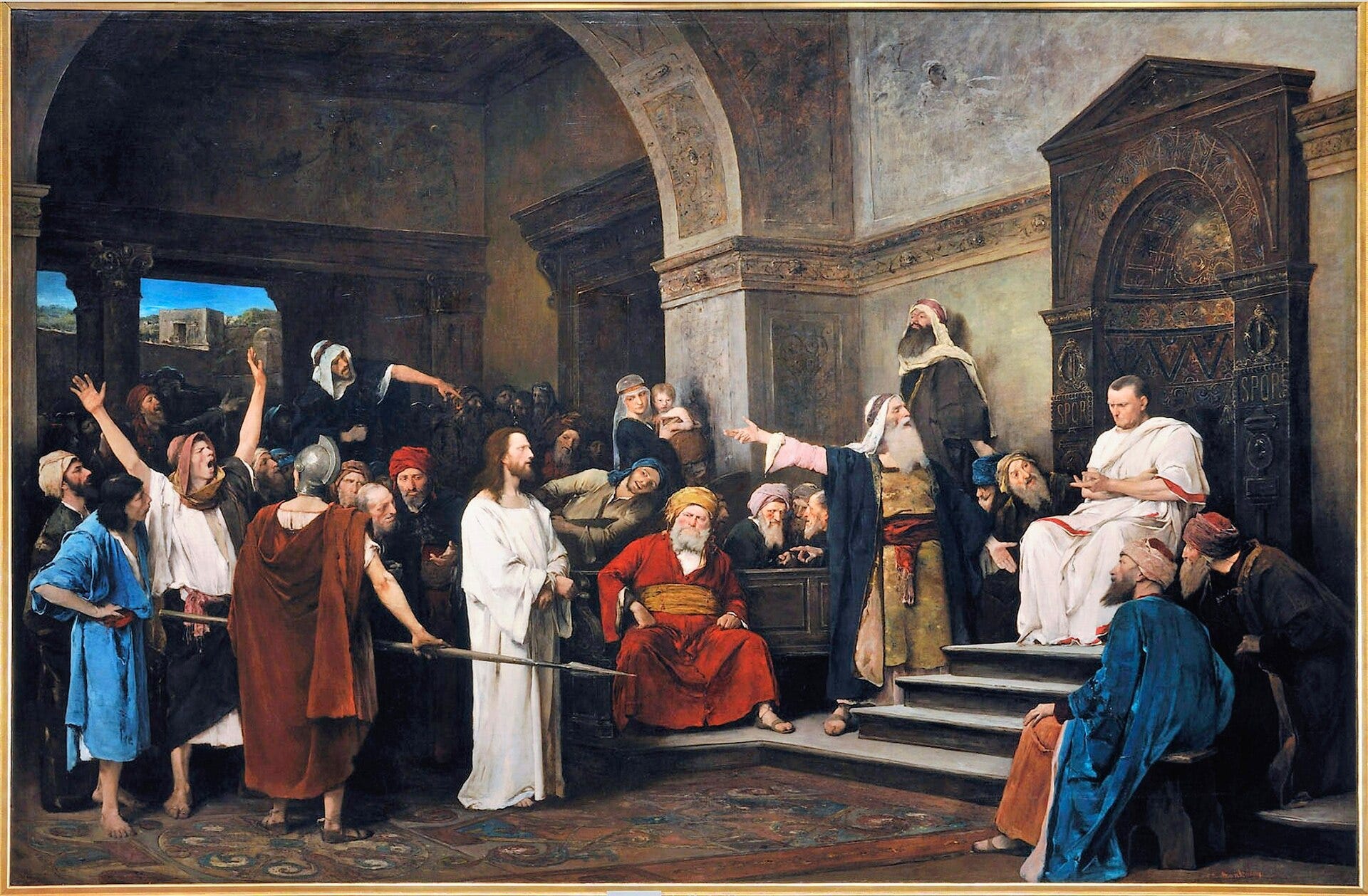
An analysis of the contemporary dossier of abuse within the Catholic Church in light of law and truth. Constructed in the order of Thomas Aquinas (lex aeterna — lex divina — lex naturalis — lex humana), with the Socratic method applied to the central question of whether the contemporary handling of abuse within the Catholic Church produces truth. The thesis: a broad arsenal of law-like procedures has taken the place of truth-finding, with the consequence that the higher layers of law — what Aquinas calls eternal, divine, and natural — are systematically violated.
Date: 14 May 2026.
Introduction — Pilate’s question
“Pilate said to him, ‘So you are a king?’ Jesus answered, ‘You say that I am a king. For this I was born, and for this I have come into the world, to bear witness to the truth. Every one who is of the truth hears my voice.’ Pilate said to him, ‘What is truth?’” — John 18:37–38
The Roman governor asks his question and does not wait for an answer. He steps outside, washes his hands, and nonetheless delivers the Innocent One up to the crowd. In the legal system he represents, truth has become an uncomfortable category. Procedure takes its place. The procedure was — measured against the Roman legal order — correct. Truth was not served. Pilate knows Jesus is innocent (Jn 18:38; 19:4–6) and surrenders him anyway. The hands are washed in a gesture that has since become proverbial.
Two thousand years later the question stands on the table again, in a different form. When we speak today about abuse within the Catholic Church and its handling, we speak of law. We speak of victims, institutions, compensation, recognition, denial. We rarely speak of truth as a category in its own right on which law ought to rest. We speak of what has come out of procedure, what has been deemed plausible, what has been recognized, what has been paid out. Not of what is.
This essay takes the question back. It does so in the order of Thomas Aquinas, who in his Summa Theologica (I-II, qq. 90–97) distinguished four layers of law — eternal, divine, natural, and human. It does so in the Socratic method, which presents objections in their strongest form before refuting them. And it does so with Scripture as a constant touchstone — for without that touchstone, the possibility of speaking about law as anything more than procedure collapses.
The thesis of this essay: the contemporary legal apparatus for abuse within the Catholic Church does not produce truth. The criminal law does — but only in a few dozen cases worldwide over a quarter-century. The civil law produces liability, not truth; it is built on a lower threshold and aims not at the individual perpetrator but at the institution. The quasi-pastoral, quasi-judicial instrument — the complaints commissions, compensation schemes, redress mechanisms — produces something that presents itself as truth-finding without the safeguards thereof. It operates in the domain of truth; it does not deliver truth. And thereby it violates principles that, in Aquinas’ terms, belong to the three higher layers — lex aeterna, lex divina, lex naturalis — principles that Scripture, under other names, consistently defends.
This is not a defense of what has actually happened in the abuse dossier. It is an inquiry into what is claimed about it as true, and on what grounds.
I. The four laws — Aquinas
Before the question can be treated, it must be made clear what law is. Aquinas distinguishes four layers.
Lex aeterna — the eternal law. This is the ordering principle of reality as it exists in God’s intellect. It is not made by God; it is God in his ordering knowing. All reality has its measure in this law. It is not directly accessible to the human intellect — for we do not know God’s intellect immediately — but it is accessible in its irradiations into the lower layers.
Lex divina — the divine law. This is that part of the eternal law that God has explicitly revealed to man through Scripture. The Mosaic law, the prophetic word, the evangelical law brought by Christ. Thy word is a lamp to my feet and a light to my path (Ps 119:105). For those who acknowledge Scripture as revealed, here is direct access to what the eternal law asks of man.
Lex naturalis — the natural law. This is that part of the eternal law that the human reason itself can know. When Gentiles who have not the law do by nature what the law requires, they are a law to themselves, even though they do not have the law. They show that what the law requires is written on their hearts (Rom 2:14–15). Aquinas takes this Pauline statement as the foundation of natural law. What is fundamentally good or evil can be known even by the unbelieving man, for it is inscribed in human reason.
Lex humana — the human law. This is positive law, established by human legislators. Statutes, codes, jurisprudence. In the Thomistic order, lex humana is a derived category: it is valid only insofar as it flows from lex naturalis. A human law that conflicts with the natural law is not a law but a perversion of law.
Here Aquinas cites Augustine: Lex iniqua non est lex — an unjust law is no law. This is no mere rhetorical flourish; it is a principle of legal philosophy. When a human law violates the higher layers — when it conflicts with what God has revealed or what reason itself recognizes — it loses its binding force as law. It becomes something else: a procedural apparatus that bears the name law without its essence.
For our reflection a specific test follows. When we ask after the law that handles the dossier of abuse within the Catholic Church, we ask not only whether it is procedurally correct — that is a lex humana question. We ask whether it agrees with the higher layers — lex naturalis (what reason itself requires of justice), lex divina (what Scripture explicitly teaches about law and witness), and ultimately lex aeterna (what appears as just in God’s ordering knowing). A law that is procedurally correct and violates the higher layers is, in Aquinas’ system, no law. It is the decay of law.
For anyone who stands within a Catholic legal philosophy — and the Catholic Church stands there, in her own magisterial tradition for centuries — this is not an optional test. It is the way law must be judged. It is therefore a striking irony that this very institution is today struck by legal mechanisms that, in her own philosophical idiom, would be classified as lex iniqua.
II. Truth as touchstone
Before the Quaestio can be posed, one further clarification. Truth in this reflection is not what contemporary usage usually makes of it. It is not authentic experience, not social consensus, not procedural result, not recognition. It is, in the biblical and philosophical sense, adaequatio rei et intellectus — correspondence between what the mind asserts and what is.
Aristotle defines truth as agreement between judgment and reality. Aquinas takes over this definition and refines it. A statement is true when it says what is. It is false when it says what is not. Between saying-that-something-is and being stands reality itself. No procedure, no social arrangement, no consensus can replace this relation.
Scripture goes considerably further. I am the way, and the truth, and the life (Jn 14:6). Truth is not an abstract quality but a personal reality — Christ himself. The Holy Spirit, who is promised by him to his disciples, is called the Spirit of truth (Jn 14:17; 15:26; 16:13). This Spirit will guide you into all the truth. Scripture distinguishes this Spirit of truth from other spirits: Beloved, do not believe every spirit, but test the spirits to see whether they are of God (1 Jn 4:1).
For law a grave demand follows from this. You shall not bear false witness against your neighbor (Ex 20:16) — not you shall follow the procedure. A false witness will not go unpunished, and he who utters lies will not escape (Prov 19:5). The Mosaic two-witness rule (Deut 19:15) requires not plausibility but that a charge be sustained on the word of two or three witnesses. A man who bears false witness against his neighbor is like a war club, a sword, or a sharp arrow (Prov 25:18) — three metaphors for instruments of violence, a revealing choice.
This is the horizon within which what follows takes place. Truth is correspondence with reality. Law ought to rest on truth. When a procedure cannot produce truth — through lowered thresholds, through the absence of judicial safeguards, through the exclusion of the opposing party’s hearing — then it may produce something else (compensation, recognition, institutional shift), but not the truth on which law ought to rest.
III. The Quaestio
Quaestio: Whether the contemporary handling of abuse within the Catholic Church — through the cooperation of criminal law, civil law, and quasi-pastoral complaints mechanisms — produces truth in the sense that Scripture and philosophy ascribe to it.
Videtur quod — it seems that it does produce truth
First objection. The criminal law has been considerably relaxed for sexual offenses over the past quarter-century. The Dutch Sexual Offenses Act of 1 July 2024 redefines rape from coercion and threat to acting against the will; introduces negligent rape as a new category; lengthens sentences; abolishes the statute of limitations for serious offenses against minors (as of 1 April 2013). The thresholds have been lowered. What passes through criminal procedure under these relaxed thresholds is therefore truth in any reasonable sense.
Second objection. The civil law offers a complementary framework where criminal law cannot reach. Civil limitations periods have been made breakable by Dutch Supreme Court case law (the Van Hese heirs doctrine since 2000); employer liability (Art. 6:170 of the Dutch Civil Code) makes institutions liable for the acts of their officials; tort (Art. 6:162 of the Dutch Civil Code) reaches institutional fault. What is established civilly has been weighed by a judge — that is a form of truth-finding.
Third objection. The ecclesiastical complaints procedures have operated since 2011 on the standard of plausibility. Investigators weigh documentation, hear complainants and respondents, and issue an advisory opinion. What is deemed plausible by these procedures cannot be set aside as arbitrary. It has been weighed, documented, and judged by a commission of experts.
Fourth objection. The broad international reports — the Deetman Commission (Netherlands 2011), the Ryan, Murphy, and Cloyne Reports (Ireland 2009–2011), the John Jay Reports (US 2004, 2011), the MHG Study (Germany 2018), the CIASE/Sauvé Report (France 2021), the Pennsylvania Grand Jury Report (2018), the Royal Commission Final Report (Australia 2017) — together form a scientific and legal foundation. They identify thousands of perpetrators and hundreds of thousands of victims. What is established by so many reports in so many countries cannot reasonably be contested.
Fifth objection. Recognition of victims, in the form of compensation and official validation of their account, is itself a form of truth. Someone whose suffering is recognized by state or church knows that his experience has been taken seriously and officially registered. What is recognized by the state or by an ecclesiastical body acquires the status of truth.
Sixth objection. The alternatives are worse. Without this apparatus, victims of time-barred or evidentiarily difficult facts would have no recourse. We must not choose between the current system and a better system but between the current system and nothing. The current system is therefore preferable, and the truth it produces must therefore be accepted.
Sed contra — but on the contrary
But on the contrary Scripture says: Only on the evidence of two witnesses, or of three witnesses, shall a charge be sustained (Deut 19:15). Not plausible; sustained. He who states his case first seems right, until the other comes and examines him (Prov 18:17). Not validation of the first account; examination by the second. He who justifies the wicked and he who condemns the righteous are both alike an abomination to the LORD (Prov 17:15). Not asymmetric preference for one of the two judicial errors; symmetric care.
Augustine says: non videtur esse lex quae iusta non fuerit — that which is not just does not seem to be law. Aquinas concurs. A procedure that holds itself out as truth-finding while systematically circumventing the biblical requirements for it (two witnesses, hearing and counter-hearing, individual guilt, symmetric care) is, in Aquinas’ terms, no law but the decay of law. What it produces may be called plausibility, may be called liability, may be called recognition — but it may not be called truth in the sense Scripture and philosophy ascribe to it.
Respondeo — I answer that
I answer that the contemporary handling of abuse within the Catholic Church does not produce truth in the sense of adaequatio rei et intellectus. It produces something else — a mixture of liability, recognition, compensation, and institutional shift — that in public perception is treated as truth but that, in legal, philosophical, and theological terms, is not. This for three converging reasons.
First reason — the threshold. Truth in the legal sense requires a high degree of certainty. The criminal law uses lawfully and convincingly proved; in doubt, in favor of the defendant (Beccaria 1764; Roman law’s in dubio pro reo). A civil plausibility ruling uses a lower threshold — sufficient likelihood on balance. A complaints commission’s plausibly made out uses a still lower threshold — pastoral-administrative, without oath, without cross-examination, without independent weighing of evidence. What appears as the outcome of these low-threshold procedures is by definition not the establishment of what happened; it is a probability judgment under a deliberately lowered standard. Between probable and true lies a distance that philosophy has guarded since Aristotle, and that no procedure can bridge by declaring itself to be truth.
Second reason — the opposing party. Truth about an individual act requires that the act be established against an individual, in a procedure in which that individual can defend himself. Criminal law does this: it judges a person, on his acts, with his defense, under oath, open to appeal. Civil law in abuse cases structurally does not: it judges an institution, on the basis of plausibility that its official did something, without that official being a party to the proceedings. The complaints commission does not do this at all: it judges an individual without the individual procedure that legal philosophy has required for centuries. Fr. Adriaan on Martinique is no party to the civil relationship between complainant and abbey. What is accepted about him, he cannot contest with his own defense. His name comes out; his truth does not.
Third reason — the absence of the highest legal test. In Dutch criminal law — and in every comparable legal system — the prosecutor of offenses is not the victim, not the press, and not a complaints commission. The prosecutor is the Public Prosecution Service (Openbaar Ministerie, OM). The OM has autonomous authority to prosecute criminally even without an individual victim filing a complaint. The OM has access to ecclesiastical reports, complaints-commission rulings, and public names. The OM has no institutional or financial interest in protecting the Church; on the contrary, it stands under political and public pressure to prosecute in abuse cases where it can.
In the Netherlands, the Public Prosecution Service has, throughout the entire Deetman Commission period (an estimated 10,000–20,000 victims), with more than 4,000 complaints before the RKK Complaints Commission, with more than 60% sustained, with countless names in media form and in internal ecclesiastical documentation, initiated no substantial number of criminal prosecutions. No Dutch priest has been criminally convicted in this period for sexual abuse figuring in the Complaints Commission claims.
This fact is of an order rarely named in the contemporary debate. Two explanations are possible. Either the OM has, for reasons of capacity or prioritization, neglected to bring prosecutions for which a ground existed. Or the OM has, after investigation or assessment, found no prosecutable ground in the overwhelming majority of alleged facts.
In a healthy legal order the first explanation is implausible. The incentives do not run that way: the OM stands under maximum public pressure to prosecute in abuse cases where it can; politics and justice support prosecution in these cases; examples from other countries (Pennsylvania Grand Jury 2018) show that OM-equivalents are willing to investigate en masse even where limitations periods bar prosecution. The second explanation is therefore more likely: in the majority of claims that complaints commissions have deemed plausible, the OM has found no prosecutable ground.
The criminal law is — in every continental European legal system — the highest organ of truth-finding. What passes through the criminal-law filter we know with legal certainty; what does not pass through it — not because there was no complaint, but because the OM itself found no prosecutable ground — about that we do not have legal certainty in the same sense. That a claim has been deemed plausible in civil proceedings, that compensation has been paid, that a name has been published, does not fill this truth-deficit. It confirms it.
Ad objectiones — replies to the objections
On the first. The relaxation of criminal-law thresholds over twenty-five years has not produced a corresponding increase in criminal convictions for abuse within the Catholic Church. On the contrary: the thresholds have been lowered, and the number of Dutch convictions for sexual abuse by priests remains at zero. That strengthens rather than weakens the thesis that in the overwhelming majority of alleged facts, no prosecutable ground exists. When the law softens itself and the outcome remains the same, it is not the law that solved the problem; it is something about the cases themselves that admits no judicial resolution.
On the second. Civil-judicial involvement produces no truth at a lowered threshold. A judge who rules on plausibility rather than proved is not engaged in criminal truth-finding; he is engaged in a weighing of probabilities. Moreover: civil proceedings in the overwhelming majority of cases do not proceed to a judicial ruling. They are settled — settlement agreements are signed, releases granted, names handled in confidentiality. A settlement is not a judicial ruling; it is a negotiated outcome. Even where settlements are approved by judges in Chapter 11 proceedings (as in American diocese bankruptcies), judicial involvement is administrative, not substantively factual. The judge approves the arrangement; he does not establish what happened.
On the third. The complaints commissions of the Catholic Church and comparable ecclesiastical bodies are not designed as truth-finding organs. They are designed as pastoral recognition-and-compensation instruments. Their plausibility rulings are intended as thresholds for pastoral recognition, not as judicial findings. When their rulings function in media form and public perception as judicial findings, a shift occurs that the commissions themselves did not intend, and for which their working methods are not equipped.
On the fourth. Broad international reports are not automatically truth. They are research documents of variable methodological quality. The Deetman Commission produced estimates (10,000–20,000 victims) found not reproducible by Professor P. van der Heijden (Chair in Statistics, Utrecht). The CIASE report in France (Sauvé 2021, 330,000 estimate) has been heavily criticized methodologically. The John Jay Report (US 2004, 2011), by contrast, is comparably rigorous and arrived at substantially lower figures (4,392 priests out of approximately 100,000, or 4%). The claim that so many reports in so many countries say the same thing does injustice to the variable quality of what they actually establish. That they all establish a problem, is correct; that they all establish the same scale of the problem, is not.
On the fifth. Recognition is not truth. Recognition is a socio-pastoral phenomenon in which an institution validates a complainant’s suffering. Validation is something other than establishment. An institution can recognize a complainant without what he claims corresponding to reality; it can do so out of pastoral motives, reputational concern, financial calculation, or sincere compassion. None of these motives bears on the question of whether his claim is true. Moreover a specific dynamic presents itself here: a payment creates, in public perception, the impression of a guilty verdict. If the Church pays five thousand euros, then surely it must be true — otherwise she would not pay. This reasoning is plainly wrong in the financial world (institutions settle to avoid liability and litigation costs, not as admissions of guilt), but in the public perception of the abuse dossier it is applied almost universally. The payment functions in the domain of truth — it is read as a truth-claim — while in legal and philosophical terms it produces no truth. That is the sharpest form of the structural deception.
On the sixth. The alternative is not nothing. The alternative is a legal system honest in its claims. An apparatus that offers pastoral recognition without presenting itself as truth-finding; that pays compensation without rendering individual guilty verdicts; that refers to the criminal law where it can, and is clear where it cannot; that maintains in its own communication the distinction between plausible and proved; that does not pretend to deliver what it cannot deliver. The American Dallas Charter (2002) does the first in part — it delegates fact-finding to the civil authorities and confines itself to compliance enforcement. The Dutch Complaints Commission does the other — it judges individual plausibility itself and so supplies the building blocks for the quasi-judicial function in which its rulings then function in media form. That is a choice, not an inevitability.
IV. Where abuse sits within lex humana
Once the Quaestio has been answered, the factual balance can be drawn up. Within what lex humana framework does abuse within the Catholic Church fall, and how do the various frameworks relate to one another?
Sexual abuse falls — more so than almost any other act — within several legal forms simultaneously. It is primarily criminal: an offense under Articles 242 (rape), 244–247 (sex offenses against minors), 246 (sexual assault), and 249 (indecent acts in a relationship of dependency) of the Dutch Penal Code. This is the framework in which individual guilt is established, with judicial safeguards, under oath, open to appeal.
It is secondarily civil: a ground for damages against the individual perpetrator (Art. 6:162 of the Dutch Civil Code, tort) and against the institution that had him in office (Art. 6:170 of the Dutch Civil Code, employer liability). This framework establishes liability for damage, not guilt for an offense.
It is also canonical within the Church: 1983 Code of Canon Law, canon 1395, and the legislation built upon it — Sacramentorum Sanctitatis Tutela (2001, revised 2010 and 2021) — with the Dicastery for the Doctrine of the Faith as the competent Vatican body. Vos estis lux mundi (2019, revised 2023) requires reporting to civil authorities where the law so requires. This framework is internal to the Church; it has its own procedures, its own sanctions (suspension, dismissal from the clerical state), its own institutions.
It touches on administrative law insofar as institutions fall under state supervision (youth care, education, child care); and on public international law in exceptional cases (Rome Statute, Art. 7, on sexual slavery as a crime against humanity). It touches on human rights via ECHR Art. 3 (prohibition of inhuman treatment) and Art. 8 (bodily integrity). It touches on disciplinary law for certain professional groups — but not specifically for priests, as they are not subject to professional registration.
And finally it is handled in quasi-judicial mechanisms — complaints commissions, compensation schemes, redress mechanisms — which fit into none of the classical legal forms. Pastoral in intent, civil in consequence, administrative in operation. A hybrid without a legal form of its own.
How has the Dutch dossier of abuse within the Catholic Church in fact been handled within these frameworks?
Criminal law: almost absent. No Dutch priest has been criminally convicted for sexual abuse figuring in the Complaints Commission claims. The primary legal framework has not been used.
Civil law: limited. A few cases (Gijsen 2018, District Court Gelderland), but marginal in relation to the thousands of Complaints Commission claims. The secondary legal framework has been limitedly used.
Canon law: only for the most serious internationally visible cases. The Vesseur and Quartier proceedings run within this framework, but for the other accused in the Complaints Commission claims canon law has not been substantially applied.
Disciplinary law: not applicable (priests are not professionally registered).
Administrative law: not primarily applicable (churches do not fall under regular government supervisors).
Public international law: not at issue.
Human rights: marginal (no European Court of Human Rights rulings on Dutch ecclesiastical handling).
Quasi-judicial (Complaints Commission + Compensation Scheme): virtually all handling has been concentrated here.
Of the seven legal frameworks within which abuse within the Catholic Church belongs, one has been primarily applied — the quasi-judicial — which is no classical legal form and offers no judicial safeguards. The six legal frameworks that do offer safeguards have, in the overwhelming majority of alleged facts, not been applied.
That is not a procedural detail. It is a structural observation about what is in fact happening here. An act that can be handled in six classical legal frameworks is not handled in five of them and only marginally in one — and the mass handling takes place in a seventh framework that is no legal form at all.
V. What stands criminally established — the names we know
The criminal law has, in the worldwide dossier of abuse within the Catholic Church over a quarter-century, produced a number of convictions. Their names can be named; their judgments can be verified; their cases have been widely reported, dramatized in Hollywood, and are internationally known. For these cases, truth in the sense of adaequatio rei et intellectus holds: what has been pronounced about them corresponds with what is.
In Boston: John J. Geoghan — convicted 21 February 2002, 9–10 years for indecent assault and battery on a 10-year-old in a Waltham swimming pool in 1991. Murdered in detention on 23 August 2003. Paul Shanley — convicted February 2005, 12–15 years for statutory rape and indecent assault of a 6-year-old at St. Jean’s parish in Newton, 1983–1989. Ronald H. Paquin — convicted December 2002 on his own guilty plea, 12–15 years for child rape in Haverhill 1989–1992. The first Boston priest to plead guilty.
In Ireland: Brendan Smyth — Norbertine, convicted 1994 and 1995 in Northern Ireland (43 offenses against 21 children, 1964–1984); died in HMP Maghaberry on 22 August 1997. Ivan Payne — Dublin, convicted 26 January 1998, 6 years for 14 sample charges against 8 boys (aged 11–14) at Our Lady’s Hospital for Sick Children. Tony Walsh — Dublin, “the singing priest”, convicted multiple times since 1995 for 38 sex offenses against schoolboys. Eugene Greene — Diocese of Raphoe, Donegal, convicted 2000, 12 years for 41 sample charges against 26 boys 1965–1982. Oliver O’Grady — Irish priest who worked in California; convicted there in 1993, 14 years; later in Ireland in 2012 and 2020 for child pornography. Donal Collins — Ferns, convicted March 1998, 4 years.
In Pennsylvania: John T. Sweeney — Greensburg, convicted July 2018, 11½ months to 5 years. The first person criminally punished as a direct result of the Pennsylvania Grand Jury Report 2018. David Poulson — Erie, convicted January 2019, 2½ to 14 years. Msgr. William J. Lynn — Philadelphia, convicted June 2012, 3–6 years for child endangerment (cover-up, not abuse itself). The first high-ranking cleric in the United States convicted for covering up abuse by others.
In Australia: Gerald Francis Ridsdale — Ballarat, convicted multiple times 1993–2017, ultimately 40 years’ imprisonment for 65 child victims. The uncle and mentor of George Pell. Died 18 February 2025. Michael Glennon — Melbourne, convicted 1978, 1991, 2003 (multiple times), 33½ years with 26½ years non-parole. Died in detention 1 January 2014. Vincent Gerard Ryan — Maitland-Newcastle, convicted October 1995 (14 years) and May 2019 (3 years 3 months). Died 13 April 2022.
George Pell — cardinal, originally convicted in December 2018 but unanimously quashed 7–0 by the High Court of Australia on 7 April 2020. Does not count, therefore, as a criminal conviction. The Pell case illustrates the functioning of a healthy legal order: a conviction was rigorously reviewed on appeal and overturned when the highest court found that “there is a significant possibility that an innocent person has been convicted because the evidence did not establish guilt to the requisite standard of proof.”
These are the names. For them the Mosaic rule of law — every charge must be sustained by the evidence of two or three witnesses (Mt 18:16; 2 Cor 13:1) — has been observed, in its criminal-law equivalent. Their acts have been established in procedures that have kept the criminal-law safeguards. Of them we may speak in the sense of truth: they have done what was charged against them. For their acts Scripture knows specific words of condemnation: Whoever causes one of these little ones who believe in me to sin, it would be better for him to have a great millstone fastened round his neck and to be drowned in the depth of the sea (Mt 18:6).
It is important to state this at the outset, before the broader analysis. Actual abuse by actual priests has taken place. This is no open question. It has been judicially established. The number of victims per individual convict is substantial — Ridsdale 65, Greene 26, Smyth possibly 143, Geoghan at least 130 according to allegations. The cover-up by specific superiors (Cardinal Law in Boston, Cardinal Mahony in Los Angeles, the Irish bishops from the Murphy and Cloyne Reports) is documented in internal ecclesiastical archives made public in civil proceedings.
This we know. About this no reasonable doubt exists.
But this is what we know — and not what we know. Between these roughly fifteen names and the thousands or hundreds of thousands that shape the picture in public perception lies the terrain about which truth in the same sense cannot be established.
VI. The second instrument — civil law in operation
Alongside the criminal law, in the past twenty-five years, a broad civil-legal apparatus has formed around the dossier of abuse within the Catholic Church. This apparatus has produced outcomes of a scale not conceivable in criminal procedure.
The Archdiocese of Boston: more than $200 million paid out in claims. The Archdiocese of Los Angeles: $660 million in a single settlement in 2007 for 508 victims. Diocesan bankruptcies in the United States since 2004: more than 30 in number — Portland, Tucson, Spokane, Davenport, San Diego, Wilmington, Milwaukee, Helena, Saint Paul–Minneapolis, Duluth, Stockton, Great Falls–Billings, Rochester, Buffalo, Camden, Syracuse, Rockville Centre, Albany, Norwich, and others. Total paid out by American dioceses: more than $4 billion.
The Pennsylvania Grand Jury Report (August 2018) identified 301 predator priests in six Pennsylvania dioceses, with more than 1,000 victims over seven decades. Two of these 301 were criminally prosecuted; the remaining 299 were deceased, time-barred, or not prosecutable. But 301 names appeared in public form — as perpetrators — without judicial establishment.
The New York Child Victims Act (2019) opened a one-year look-back window (later extended to two years owing to COVID) in which victims could file civil claims notwithstanding the limitations period. Result: more than 10,000 new claims filed, primarily against Catholic Church institutions and Boy Scout organizations. The Diocese of Buffalo went Chapter 11; Rockville Centre did the same; Albany followed in 2023.
The apparatus has, in financial scale and in the number of names named, built an unprecedented edifice on the criminal-law foundation of a few dozen convictions. A multiple of the number of criminally convicted perpetrators is named by name in civil proceedings and compensation schemes — without criminal-law establishment of their individual acts.
What civil law legally establishes is the following: it is sufficiently plausible that damage was caused by acts for which the institution sued can be held liable. It does not establish: the perpetrator committed the acts, the person sued is guilty, the alleged facts are true. It says: it may have happened in a way sufficiently probable to require the institution to compensate.
That is a fundamentally different statement from a criminal conviction. But in public perception the distinction is not maintained. When an archdiocese pays out $200 million, the average reader reads: the abuse is proved, the perpetrators are guilty, the Church has admitted it. When 301 priests are named in a Grand Jury Report, the average reader reads: 301 perpetrators. When a diocese goes Chapter 11 under the pressure of claims, the average reader reads: the Church admits she is guilty.
None of these readings accords with the actual legal status. But the media form does not preserve the distinction. A civil-law ruling comes conceptually to function as a criminal conviction. That is not a question of legal-formal admissibility — civil law may exist, civil law may operate on lower thresholds. It is a question of what the cumulative working does. Through the systematic merging of two legal categories in public form, a third category emerges — a quasi-criminal outcome that has never been pronounced by a criminal judge but that is identical in social consequences to a criminal conviction.
VII. The third instrument — quasi-pastoral, quasi-judicial
The most consequential mechanism is the third, and it is structurally the least examined. It is the instrument that fits into no classical legal form — pastoral in intent, civil in consequence, administrative in operation, functioning in public perception as judicial pronouncement.
In the Netherlands: the Complaints Commission and Compensation Scheme of the Roman Catholic Church, established in 2011. More than 4,000 complaints filed. More than 60% sustained on the threshold “plausibly made out”. Compensation amounts up to €100,000. Comparable bodies in other countries: the Adriaenssens Commission in Belgium (2010, maximum €25,000); the Residential Institutions Redress Board in Ireland (2002, more than €1.5 billion in state outlays); the Anerkennungsleistung in Germany (since 2011, raised in 2020 to a maximum of €50,000); INIRR in France (since 2022, maximum €60,000); the National Redress Scheme in Australia (since 2018, maximum AUD $150,000); the Indian Residential Schools Settlement Agreement in Canada (2007, CAD $1.9 billion with the federal state as principal payer).
What these bodies have in common:
A lower evidentiary threshold than criminal law — usually plausible on the basis of a written statement, sometimes supported by limited corroborating evidence
Administrative working methods — no judicial involvement in individual assessment, no oath, no cross-examination
Release upon payment — the complainant signs a settlement agreement that bars further claims
Maximum amounts per case — no open-ended civil liability
A pastoral or state-recognitive tone — the payment is presented as recognition, not as a judicial finding
This kind of legal apparatus is a twentieth-century innovation — emerged as a response to the need to address historical injustice en masse without exceeding the capacity of the courts and without forcing victims into litigation. It is, in its nature, something new. It does not fit within criminal law; it does not fit within civil law; it does not fit within disciplinary law; it does not fit entirely within canon law (though it lies close to it). It is a hybrid.
For the purpose for which it was designed — offering pastoral recognition, arranging compensation, creating finality — this hybrid is workable and to a limited extent defensible. The problem arises when this hybrid begins to function as truth-finding. And in the modern media world that happens inevitably.
The pivot — the payment as perception of a guilty verdict.
Here lies the sharpest form of what is structurally wrong in this dossier. When the Church pays out five thousand euros to a complainant, a logic emerges in public perception that runs as follows: if the Church pays, there must be something to it; otherwise she would not pay. The payment is read as an implicit confession of guilt. It must be true — otherwise they wouldn’t pay.
This reasoning is manifestly wrong in any other institutional context. When an insurance company pays out a claim, that is no admission that the alleged damage was caused by the covered event — it is a commercial trade-off between claim payment and litigation costs. When a municipality settles a liability claim, that is no admission of fault — it is procedural-risk management. When a company settles a wage-and-hour claim, that is no confession of guilt — it is file-closure.
But in the church dossier the reasoning is reversed: she pays, therefore she admits. And this is precisely the reasoning that makes the quasi-judicial instrument function as truth-finding. The Church cannot pay without her payment being read as a guilty verdict. She also cannot not pay without her refusal being read as cover-up. Both options produce a truth-claim that has not been legally established.
This is — to speak in Aquinas’ terms — the place where lex humana withdraws from lex naturalis. The natural law demands that the bearer of a judicial finding have actually made that finding — not that a payment be read as if it had made it. The Mosaic law demands two witnesses for the sustaining of a case (Deut 19:15) — not one payment read in public perception as a testimony. Scripture demands hearing and counter-hearing (Prov 18:13; Jn 7:51) — not an administrative process without cross-examination.
The quasi-judicial instrument functions in the domain of truth. It produces no truth. It is, in Aquinas’ rigorous categorization, lex iniqua: procedurally correct, materially unjust. Decay of law, not law.
VIII. The violation of lex aeterna, lex divina, lex naturalis
What these three instruments together violate can be formulated in four specific principles. Each principle is explicit in Scripture, knowable in natural law, and recognizable in every developed legal order.
First — the two-witness rule (Deut 17:6; 19:15; Mt 18:16; 1 Tim 5:19). Only on the evidence of two witnesses, or of three witnesses, shall a charge be sustained. A single witness shall not prevail against a man for any crime or for any wrong in connection with any offense that he has committed. This rule applies in Mosaic law for general adjudication, is intensified for capital cases, and is repeated in 1 Timothy 5:19 specifically for charges against ecclesiastical leaders. Never admit any charge against an elder except on the evidence of two or three witnesses.
In the Complaints Commission instrument this rule has structurally not been observed. A complaint with one witness against one denying respondent — often by now deceased — can lead via plausibility to a sustained finding. For an individual in the Church affected by such a ruling, this is a violation of the specifically biblical threshold that Paul set for elders. The threshold for the public accusation of a spiritual leader ought to be higher, not lower.
Second — hearing and counter-hearing (Gen 3; Prov 18:13; Jn 7:51). If one gives answer before he hears, it is his folly and shame (Prov 18:13). Does our law judge a man without first giving him a hearing and learning what he does? (Jn 7:51, Nicodemus to the Sanhedrin). And most fundamentally: Genesis 3, in which God himself, in judging Adam, Eve, and the serpent, hears each of them separately. The procedure God demands of men, he himself follows first.
In the quasi-judicial instrument this principle is partly respected (respondents are usually given the opportunity to submit a statement) but essentially undermined (no cross-examination, no confrontation with opposing witnesses, no testing under oath). What in a judicial procedure would be the essence of hearing and counter-hearing — the structural testing of one account against the other — does not take place in this instrument.
Third — individual responsibility (Deut 24:16). The fathers shall not be put to death for the children, nor shall the children be put to death for the fathers; every man shall be put to death for his own sin. In the biblical legal order, guilt is individual. It does not pass to another generation, to a family, or to an institution.
The civil-law instrument violates this principle in a specific way. It holds the institution liable for the acts of its officials — which is legally defensible via employer liability — but in the same motion publishes the names of those officials, as if their individual guilt had been established. The institution pays; the names are claimed. For the Church as a whole that is a lex humana choice; for the individual father, brother, or monk whose name is published without a judicial finding, it is a violation of the principle of individual law.
Fourth — the presumption of innocence and symmetric judicial care (Prov 17:15; Dan 13; Beccaria 1764). He who justifies the wicked and he who condemns the righteous are both alike an abomination to the LORD. Two judicial errors are symmetrically grave. Not better to err in protecting victims than ever to miss a perpetrator; both errors are equally reprehensible. Susanna (Daniel 13) — two elders accuse an innocent woman; only by Daniel’s cross-examination is the truth disclosed. Beccaria’s Dei delitti e delle pene (1764): a man cannot be held guilty before a judge has pronounced a verdict.
The quasi-judicial instrument, combined with the media form in which it operates, violates this symmetry. It keeps the threshold low for finding guilt (in fact or in perception) and provides almost no mechanism for definitively clearing someone of such a finding. Plausible once published cannot be undone. The respondent whose case has been deemed plausible in a complaints commission can never restore his name through that same procedure. For a criminal acquittal — which does have a restorative function — he depends on a prosecution that the OM has chosen not to bring.
IX. What spirit moves this apparatus?
Scripture asks: test the spirits to see whether they are of God (1 Jn 4:1). For the evaluation of the apparatus that has been erected around abuse within the Catholic Church, this question is unavoidable. What spirit moves it?
An honest assessment distinguishes various motives operating side by side. The Spirit of truth — the spirit at work in a believer when he honestly inquires after facts — is present in the apparatus: real victims are recognized, real evil is named, sincere journalists do sincere work. It would be an injustice to deny this motive.
But other spirits also work, and it is here that scriptural discernment intervenes. The love of money is the root of all evils (1 Tim 6:10) — philarguria. The civil-law and compensatory apparatus knows, at several levels, financial incentives that systematically strengthen the truth-orientation on the side of the claimant and weaken it on the side of the tester.
Law firms work on a no-cure-no-pay basis against ecclesiastical institutions; their fees are percentages of awarded damages. In American class actions, fee percentages of 30–40% are usual; on settlements of hundreds of millions of dollars, this produces law-firm income of tens of millions. Their interest is not truth-finding but award. He who can generate more claims earns more. That is not bad faith; it is the structure of the incentives.
Claimants receive substantial amounts for statements not made under oath, not cross-examined, not independently tested. For the real victims this is honorable financial relief; for those who present themselves and see through the system, it is a financial opportunity with limited risk-evidence weighing. The American cases of proven fraud in compensation programs — among others in look-back window proceedings in New York and California — show that this is no hypothetical phenomenon.
Media sources sell circulation and build reputation on these dossiers. Investigative journalists win prizes, books become bestsellers, films win Oscars (Spotlight 2015, Best Picture). This is no conspiracy; it is normal media economics. But it is also not pure truth-orientation — the incentives run toward stories that work, not necessarily toward stories that are true.
Compensation commissions and their executives receive fees for prolonged work. Once an administrative structure is set up, it has its own interest in its continuation; its lack of claims is its lack of right to exist.
On the side of the tester, comparable incentives are scarce. The Church proceeds defensively, with lawyers it pays itself, but without fee incentives scaling with awards. Independent criticism is labeled by the binary frame as denial; no researcher builds a career on a report criticizing complaints-commission thresholds. The legal system itself has no internal actor that structurally interrogates truth at this point — the civil judge works on the plausibility threshold given by statute; the complaints commission works on its own pastoral-administrative standard.
The net result is that the spirit of the apparatus, honestly considered, is for a significant part not the Spirit of truth, but a mixture in which financial, institutional, and media-driven incentives converge to strengthen the claim side without comparable strengthening on the testing side. The fruit of this spirit is therefore not primarily truth — it is volume, compensation, narrative, institutional shift.
Here scriptural discernment touches on an outcome uncomfortable for many. When the love of money is the root of all evils, and when this love operates structurally on multiple levels of a legal apparatus, that apparatus is in its deepest spiritual condition affected. Not all actors act out of love of money; but the apparatus as a whole moves in a direction in which love of money moves along at multiple junctures without counterweight.
This is no charge of conspiracy. It is a sober observation of how institutions respond to the incentives they receive. Test the spirits to see whether they are of God — that is no optional pious maxim. It is a legal-philosophical obligation, rarely executed explicitly in this dossier.
X. The asymmetry of state and Church
A final structural observation belongs here, for it illuminates what the apparatus does in its operation. The same civil-legal and administrative mechanism has fundamentally different effects depending on who is sued.
Against the state it does not work effectively. The Dutch childcare-allowance scandal (toeslagenaffaire) has cost the state more than €5 billion; no ministry has disappeared, no government building has been sold, no specific official has been named in the Compensation Scheme, no branch of the state has been dismantled. The state has, for practical purposes, infinite money — it levies taxes, borrows on the capital markets, shifts costs across generations. A claim of billions against the state is administratively troublesome but institutionally cosmetic.
Against the Church it does work. An American diocese confronted with $200 million in claims goes Chapter 11. Specific churches are sold. Parishes are merged or closed. Schools disappear. Specific priests are publicly identified on credibly accused lists. Religious communities are dismantled. The Church has finite assets and finite insurance coverage; civil claims can actually destroy institutions.
The same legal mechanism — administrative compensation on a lowered threshold — works as cosmetic correction for the state and as existential threat for the Church. That is not a question of what is legally proper; civil law may exist, damages may be compensated, institutions may be held liable. It is a question of what the cumulative working brings forth: a legal system that, applied to the state, yields cosmetic correction, and applied to the Church, yields institutional dismantling.
In the Netherlands this is visible in the pace at which ecclesiastical real estate has been sold since 2010, parishes have been closed, and monastic communities have shrunk or disappeared. For the state over the same period the opposite holds: notwithstanding substantial liability payments, the Dutch state has grown institutionally, not shrunk.
What is in fact happening here is a shift of powers. An institution that for a long time was culturally, socially, and morally dominant in Western societies — the Catholic Church — has, through a combination of actual abuse in her ranks, journalistic disclosure of that abuse, civil-law liability, media formation, and public discourse, been effectively dismantled as a dominant institution. This is not happening only because of what her officials have done. It is happening because of what the apparatus we have built for the handling of what they have done structurally produces. For other institutions where comparable wrongs have been committed — the state, schools, sports clubs, youth care — the same apparatus does not work or barely works. For the Church it works decisively.
The Church is, in the modern institutional legal order, the only truly vulnerable target. That is not intended; it has grown structurally so. But so it is.
XI. What stands
When the Quaestio has been answered, the factual balance drawn, the spirit discerned, and the asymmetry named, the theses that stand can be sharply formulated.
First thesis. Abuse within the Catholic Church has actually taken place. For a number of identifiable priests, with identifiable victims, in identifiable circumstances, this has been criminally established. We know their names; we know what they did; we know that their superiors in a number of cases protected them and covered up their actions. About this no reasonable doubt exists.
Second thesis. The criminal investigation that led to these findings has, in the legal systems discussed — the United States, Ireland, Australia, the United Kingdom, Germany — to our best judgment been done well. The High Court of Australia quashed one conviction (Pell) after extensive review; that is a sign of a functioning legal order, not of its failing. The other convictions may be accepted as truth.
Third thesis. The entire Dutch Complaints Commission procedure, with more than 4,000 claims and more than 60% sustained, with an estimated 10,000–20,000 victims in the Deetman report, has yielded no criminal conviction of any individual priest for sexual abuse. The Public Prosecution Service, notwithstanding its autonomous authority and its institutional independence from the Church, has found no prosecutable ground in these claims. The same pattern holds in every comparable legal system: a fraction of the claims is criminally prosecuted, a fraction of those convicted.
Fourth thesis. The distinction between truth (criminally established) and plausibility (civilly or in complaints commission accepted) is no technical legal subtlety. It is a distinction of philosophical and theological order. A procedure on a lowered threshold without judicial safeguards produces no truth; it produces compensation and social validation. He who mistakes the one for the other errs in a way Scripture explicitly warns against.
Fifth thesis. For the overwhelming majority of claims handled in compensation schemes, civil proceedings, and media form, no truth has been established. What has been established is plausibility on a lowered threshold. Whether these claims correspond with reality, we do not know. We therefore do not know that they are untrue — we know that they are not proved true.
Sixth thesis. The apparatus erected around the dossier of abuse within the Catholic Church is moved, for a significant part, by other spirits than the Spirit of truth. Financial incentives, media dynamics, institutional continuity-interests, and a binary public frame work together to strengthen the claim side without comparable strengthening on the testing side. That this is so does not make the apparatus non-existent or illegitimate — but it makes its pretension of truth-finding untenable.
Seventh thesis. In Aquinas’ legal-philosophical idiom, the quasi-judicial instrument that has become dominant in the Dutch and international dossier of abuse within the Catholic Church is lex iniqua — decay of law. It is procedurally valid in the lex humana sense, but it violates the higher layers (lex naturalis, lex divina, lex aeterna) on four specific principles at once: the two-witness rule, hearing and counter-hearing, individual responsibility, and symmetric judicial care. A law that violates the higher layers on so many points at once is, in Aquinas’ system, non est lex. This is a strong claim, but it follows logically from the philosophical order that the Catholic Church herself has taught for centuries.
Eighth and final thesis. Pilate’s question — What is truth? — has not been answered in this dossier by the apparatus that presents itself as truth-finder. It remains open, and whoever takes it seriously must receive the answers the apparatus offers with discernment. Not to deny the great cases; about those we know. Not to accept the broad claims as if they had the same weight; about those we do not know. Not to be for or against the Church; that is not the question. But to be for truth — and therefore for the distinction between what has been established and what has been accepted.
XII. Coda — what this asks of us
When Jesus says: I am the truth (Jn 14:6), he does not speak as a philosopher giving a definition. He speaks as a Person who can decide about the reality of what is. For the believer this is an existential datum: truth is no social construction, no procedural result, no consensus — it is what He says it is.
For the legal system a grave obligation follows. A legal system that lets itself think in place of him, that makes its own procedure the measure of truth, that mistakes plausibility for truth, that gives more room to financial incentives than to the weighing of testimony, that no longer offers any test to the accuser — that legal system has turned away from him and declared itself kin to Pilate. The hand-washing procedure has been refined; its underlying motion is the same.
For the press a comparable responsibility follows. He who writes about claims ought to preserve the distinction between plausible and proved. He who writes about compensation ought not to suggest that compensation is a finding of guilt. He who writes about institutions ought not to publish individual names as if they had been convicted. These are not tactical tips; they are truth-requirements.
For the Church — which is for a great part the object of these proceedings — something also follows. Not self-avoidance of what has actually happened in her ranks; about that she ought to show sincere and lasting repentance. But refusal to go along with an apparatus that treats her as universally guilty for what she did not do in all her cases. That is no apologetic; it is, ironically, love of truth in the sense Scripture asks of her. A Church that from her own Thomistic tradition knows what lex iniqua is ought not to move along in its completion.
For the reader finally: the binary frame says that all this is denial of what has happened. The frame says falsely. We know that abuse has happened; we recognize what has been criminally established; we do not reject what is real. What we do, is to preserve the distinction that Scripture, philosophy, and the Western legal tradition have together defended. Between plausible and proved lies the difference between probability and reality. Between recognition and truth lies the difference between social validation and factual establishment. Between the spirit of the age and the Spirit of truth lies the difference between what is claimed as true and what is.
What is truth? asked Pilate. He who truly wishes to know remains standing for the answer. He who washes the procedure instead repeats his error.
In Aquinas’ terms: lex iniqua non est lex. An unjust law is no law. What is taken for law in place of law is decay, and as such it must be recognized by anyone who takes law in its full meaning seriously — as derivative of lex aeterna, lex divina, lex naturalis. He who does not preserve this derivation also does not preserve lex humana — and, in the end, not truth.
“With the measure you give will be the measure you get” (Mt 7:2). That holds for the Church in her dealings with her own past. It holds equally for the apparatus that judges the Church. And it holds for whoever has built, financed, reported on, and accepted this apparatus. None of these actors stands outside the reach of that same measure. The only question is who will take it seriously when it returns.
Scriptural references follow the Revised Standard Version Catholic Edition (RSV-CE). For the detailed verification of the criminal convictions and their sources, see the earlier verification documents. For the elaboration of individual sub-aspects — civil-law liability, the international comparison, the history of complaints commissions — see the accompanying essays in this series.